Social listening (via Netbase + HUNTER: Insights)

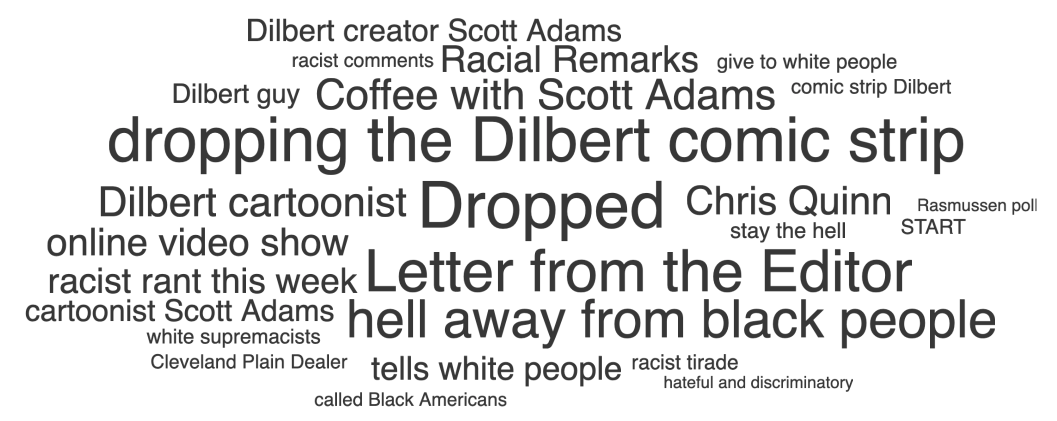
While Scott Adams, creator of the comic Dilbert, typically does not generate significant notoriety on social media – usually between 400-600 mentions per day – Adams went on a racist rant during his daily live stream on Wednesday, February 22. His remarks initially generated 1.6K social mentions, but that total jumped to 11K on Thursday as word began to spread (Examples 1, 2, 3). Mentions more than doubled the in the days following, totaling 23K mentions as publications began to drop “Dilbert” (Examples 1, 2, 3), and pressure mounted for more to follow suit (Examples 1, 2). Mentions ballooned to 70K on Saturday as major outlets began reporting on the incident (Examples 1, 2, 3, 4, 5). Momentum kept building on Sunday after Elon Musk liked Adams’ tweet defending the rant. Overall, the social sentiment in response to the incident was highly negative against Adams (6% positive, 59% negative).  

Articles of interest three to read today!

Twitter Updates Violent Speech Policy (via Social Media Today)

Twitter has updated its violent speech policy, emphasizing that the platform has zero tolerance for this language. The app did not identify exact words or phrases that will be categorized as violent speech, but the platform will be cutting down on users who incite violence and hate on the platform.   

influencer news news you can use

How Small Businesses Can Work And Leverage Influencer Marketing In 2023 (via Value Walk)

Influencers have become the funnel for fueling online and in-store commerce for brands. According to the article, around 46% of consumers surveyed claim to have bought a product or service promoted or affiliated by an influencer. More importantly, corporations have reported generating at least $6.50 for every $1.00 they invest in influencer marketing, on average.   

81% of Consumers Embraced Influencer Marketing in the Past Year, Study Finds (via Marketing Dive)

According to the study, food and beverage was the most popular influencer category, driving the highest ROI in consumer purchase behavior. Health & Wellness and Beauty categories followed closely behind. For platforms, 36% of consumers cited YouTube as the most authentic for influencer product recommendations. Regarding the style of content consumers preferred, how-to tutorials led the category at 42%, followed by short-form video content on Instagram Stories at 35%, and static photo posts at 33%.